
Disaster resilience improves when programmes are designed around the way risk is experienced. It improves through connected services, local institutions, unequal exposure and changing conditions.
Standard models can provide useful principles, but they should not replace local diagnosis, shared decision making or long-term institutional capacity.
Executive Summary
Disasters do not arise from hazards alone. Floods, droughts and fires become disasters when they interact with exposed people, infrastructure, livelihoods and ecosystems, existing vulnerabilities, and insufficient capacity to prevent or absorb their impacts. The same physical processes may also perform important ecological functions: seasonal flooding can replenish soils, while certain fire regimes help maintain ecosystem health. The distinction therefore lies not simply in the event itself, but in the social, environmental and institutional conditions through which it is experienced.
Once these conditions produce a disaster, the consequences rarely remain confined to the initial hazard. A flood can interrupt electricity, communications, transport, health care, employment and food distribution. A drought can affect water availability, agricultural production, household income, migration and political trust. Conflict, weak institutions and inequality can then amplify these impacts, producing chains of disruption that move through systems and across administrative boundaries.
This has direct consequences for international programme design. A technically sound intervention can still underperform when it is transferred from one setting to another without sufficient attention to local institutions, power relations, maintenance capacity, informal practices and the knowledge held by affected communities. Resilience cannot be delivered through infrastructure alone, and participation cannot be reduced to consultation after the principal decisions have already been made.
A best-fit approach begins with common international principles but adapts their application to the local context, institutions and affected communities. It maps dependencies between services, gives communities and other local actors a meaningful role in decision-making, identifies groups that may be underserved or excluded from protection, and develops the capacity required to sustain results after external funding ends. Programme partners then review and adapt the intervention as risks, evidence and operating conditions change.
Disaster Risk, a Programme Design Issue?
The Sendai Framework for Disaster Risk Reduction 2015–2030 established four priorities for action:
understanding disaster risk;
strengthening disaster risk governance;
investing in disaster risk reduction for resilience; and
enhancing disaster preparedness for effective response and building back better during recovery.
These priorities remain relevant because disaster risk arises through the interaction of hazards with exposure, vulnerability and capacity, all of which are influenced by development decisions. A storm may become a disaster when people, settlements, services, livelihoods and ecosystems are exposed, particularly where institutions and communities lack the capacity to anticipate, reduce, absorb and recover from its effects. Disaster risk reduction must therefore be integrated into programme design rather than treated solely as a matter of emergency preparedness and response (UNDRR, 2015).
Recent evidence gives this argument greater urgency. The United Nations Office for Disaster Risk Reduction estimates that the annual cost of disasters exceeds USD 2.3 trillion when indirect and ecosystem impacts are included. This is nearly ten times the value of direct losses recorded in official figures, although UNDRR acknowledges that the wider figure remains an estimate. For programme managers, the central point is that damage to physical assets captures only part of the burden. Lost working days, interrupted education, deteriorating health, supply-chain disruption, ecosystem degradation and the depletion of household savings can continue long after the immediate emergency has passed (UNDRR, 2025).
The economic case for investing in resilience is also substantial. The World Bank and the Global Facility for Disaster Reduction and Recovery estimated that investment in more resilient infrastructure in low- and middle-income countries could generate a net benefit of USD 4.2 trillion over the lifetime of new infrastructure. In the median scenario assessed, this represented approximately four dollars in benefits for every dollar invested. These figures are modelled global estimates and should not be interpreted as guaranteed returns for individual projects. They nevertheless support the case for integrating resilience into infrastructure planning, regulation, design, operation and maintenance, rather than addressing it only after a disaster or at the end of a project cycle (Hallegatte, Rentschler and Rozenberg, 2019).
Disasters Impacts Cascade Through a System Network
Risk assessments are often organised around individual hazards and sectors. Flood risk, public-health preparedness, transport continuity and food security may be addressed through separate plans, institutions and budgets. However, people and communities do not experience these systems separately. They experience the combined consequences when the disruption of one service affects the operation of another.
UNDRR characterises systemic risk through complex interactions, uncertainty and the potential for cascading or compound impacts. Cascading impacts occur when disruption in one part of a system produces consequences elsewhere. Compound risk arises when several hazards, drivers or vulnerabilities interact, either simultaneously or in close succession, and intensify the overall effects. UNDRR’s 2022 Global Assessment Report on Disaster Risk Reduction argues that risk management must look beyond individual hazards and strengthen cooperation across disciplines and sectors. It also calls for two-way learning between governments and communities, with this knowledge incorporated into planning and budgeting processes (UNDRR, 2022a).
The COVID-19 pandemic illustrated these interactions. The health emergency and the measures introduced to contain it had consequences for education, livelihoods and mobility, while dependence on global networks allowed disruption to produce effects at the local level. These consequences were not distributed equally. Pre-existing inequalities and vulnerabilities influenced who was most exposed, who could comply with protective measures, and who carried the greatest social and economic burden. Women and girls, informal workers, people living in poverty and groups with limited access to essential services frequently experienced distinct or disproportionate effects (UNDRR, 2022b).
For programme design, a systemic approach does not require teams to predict every possible interaction. It requires them to identify the services, institutions and relationships whose disruption could significantly worsen the consequences or obstruct an effective response. If an evacuation plan assumes functioning mobile networks, accessible roads and access to private vehicles, each dependency must be examined and alternatives provided for people who cannot rely on them. If a coastal-livelihood programme depends on uninterrupted port access, electricity, fuel supply and cold storage, the consequences of disruption to those services must be included in the risk assessment. This mapping translates systemic risk into specific design choices, contingency measures, institutional responsibilities and budget requirements.
Underperforming Standard Solutions
International frameworks are valuable because they establish shared principles, terminology and commitments against which progress can be assessed. However, problems arise when a model developed in one institutional and social setting is assumed to be universally transferable. Programme designers may reproduce its most visible features without recreating the institutional capacity, resources, relationships and public trust that enabled the original intervention to succeed.
An early-warning system, for example, is not effective merely because it produces an accurate forecast. An end-to-end, people-centred system requires risk knowledge, hazard detection and monitoring, the timely communication of authoritative and actionable warnings, and the capacity to respond. Warnings must reach people through accessible and trusted channels, in languages and formats they understand. Recipients must know what action to take and have the practical means to take it. A household may be unable or unwilling to evacuate if transport is unavailable, if leaving would expose property, livestock or livelihoods to loss, or if evacuation routes and shelters are inaccessible to persons with disabilities. Reaching the “last mile” is therefore not solely a communications challenge. It is also an institutional, social and economic design challenge (WMO, no date).
The same principle applies to infrastructure. Stronger physical assets matter, but resilience ultimately depends on whether essential services continue to function and meet users’ needs during and after disruption. The World Bank recommends clearly defined institutional mandates, the integration of resilience into regulations and incentives, better decision-making through data and skills, and appropriate financing for risk-informed planning, design and preparedness. It also emphasises effective asset management, operation and maintenance. A project that finances construction without establishing responsibility and funding for inspection, repair, staffing and recurrent costs may produce an asset whose condition and performance deteriorate after external support ends (Hallegatte, Rentschler and Rozenberg, 2019).
Best practice can show what has worked elsewhere and provide evidence, standards and lessons for future interventions. Best fit asks how those lessons can be applied in a particular setting, for whom, under which institutional conditions and with what capacity to sustain the results. The distinction does not justify lowering standards relating to safety, rights, evidence or accountability. It means adapting the delivery model, including its sequencing, partnerships, technology, communication methods and implementation arrangements, to the conditions in which the programme must operate.
From Risk to Action
Risk information has limited value when responsibilities are fragmented or institutions lack the authority, resources or incentives to act upon it. Disaster risk governance encompasses the rules, mandates, coordination mechanisms and accountability arrangements through which risk is understood, reduced and managed. It includes national legislation and policy, as well as the everyday decisions of municipalities, utilities, port authorities, health services, businesses and community organisations.
Four governance questions should be answered before an intervention is finalised. First, who is exposed to the risk and who is likely to bear its consequences? Second, which institutions have the mandate, authority and resources to reduce it? Third, who will operate, maintain and finance the intervention after external support ends? Fourth, how will decisions and responsibilities be coordinated when impacts cross sectors, administrative boundaries or jurisdictions? If these questions remain unresolved, a programme may complete its planned activities without establishing a system that can function and be sustained.
Fragile and conflict-affected settings require additional care. In such contexts, a hazard may interact with displacement, damaged infrastructure, contested authority, restricted access, disrupted markets, insecurity and low public trust. Formal institutions may have limited capacity, legitimacy or territorial reach, while informal authorities and community networks may perform essential governance and service-delivery functions. Programmes should therefore avoid assuming that a single institution represents all affected groups or can deliver services consistently across a territory.
Programme design should examine formal and informal authority, the political economy surrounding resources and services, the safety of participation, conflict sensitivity, and the possibility that an intervention could reinforce exclusion or deepen existing inequalities. Security and institutional conditions may also change during implementation, requiring adaptable activities, budgets and partnerships. This does not justify lowering standards. It requires more precise political and institutional analysis and a delivery model that can respond to changes in the operating environment (UNDRR, 2019; UNDP, 2016).
Decisions through Participation
Local and Indigenous Knowledge can identify patterns of exposure, coping practices, seasonal change, safe routes, ecosystem behaviour and social barriers that may not be captured in technical datasets. Community organisations may also know which households are geographically or socially isolated, who lacks the documentation needed to access assistance, who cannot reach an evacuation shelter and which communication channels are trusted.
These forms of knowledge can complement scientific, technical and administrative information while remaining valuable in their own right. Their inclusion does not remove the need for hazard modelling, engineering standards or public accountability. Equally, Indigenous Knowledge should not be extracted, separated from its cultural and territorial context, or treated as valid only after confirmation through conventional scientific methods. Engagement with Indigenous Peoples should respect their rights, leadership, knowledge governance and free, prior and informed consent. The IPCC concludes with high confidence that drawing on diverse forms of knowledge, meaningful participation and inclusive engagement can support locally appropriate and socially acceptable climate-resilient development (IPCC, 2022).
Meaningful participation begins early enough to influence the intervention. Affected people and representative community organisations should be able to contribute to defining the problem, comparing options, identifying risks, testing delivery mechanisms and monitoring results. Consultation undertaken after budgets, locations and technologies have been fixed may collect opinions, but it provides little opportunity to influence the programme’s central decisions. UNDRR therefore emphasises the participation and leadership of people most at risk, including women, persons with disabilities, Indigenous Peoples, displaced people and groups affected by poverty, discrimination or marginalisation (UNDRR, no date).
Participation also requires an analysis of power within communities. A public meeting may reproduce existing hierarchies if recognised leaders are treated as the sole representatives of a diverse population, women cannot participate safely, migrant workers fear contact with authorities, minority languages are excluded, or venues and materials are inaccessible to persons with disabilities. Programme teams should use several safe and accessible participation channels, document how contributions affected decisions, and report back when a proposal cannot be adopted and why. Without this feedback and accountability, participation can become extractive: people contribute their time, experience and knowledge but retain little influence over how that knowledge is interpreted or used.
Ports & Coastal Communities as an Interconnected Risk System
Ports illustrate why resilience must connect physical infrastructure, operational systems, public institutions and neighbouring communities. International shipping transports more than 80% of global trade, making the continuity of maritime transport and port operations important to supply chains and national economies (IMO, 2023a). A port is therefore more than a collection of physical assets. Its operation may depend on electricity, navigation and communication systems, road and rail access, customs and clearance procedures, labour, fuel, warehousing, cold-chain facilities, pilotage, towage and emergency services. Disruption to any of these supporting systems can affect trade, aquatic food and energy supplies, public revenue, employment and access to humanitarian goods.
This systemic understanding is consistent with IMO’s emphasis on supply-chain resilience and coordination between ships, ports, public authorities and other maritime stakeholders. IMO’s Strategic Plan for 2024–2029 recognises that disruption to international shipping has wider economic consequences and calls for collaboration among governments, maritime transport operators, ports, shippers and seafarers during crises. The mandatory Maritime Single Window further demonstrates the extent to which port operations depend on interoperable information systems: since 1 January 2024, public authorities have been required to establish, maintain and use a single-window environment for the electronic exchange of information required on the arrival, stay and departure of ships (IMO, 2023a; IMO, 2024a). Digitalisation can improve efficiency and continuity, but it also introduces dependencies on electricity, telecommunications, data governance and cybersecurity that should be included in a port risk assessment.
IMO’s technical-cooperation portfolio provides practical examples of this systems approach. Port-management training supported by IMO has addressed port organisation, ship-call operations, information systems, infrastructure maintenance, security and environmental management. The GloMEEP and GreenVoyage2050 project initiatives have produced tools for assessing port emissions, developing locally appropriate reduction strategies and improving coordination at the ship–port interface. Other IMO programmes provide guidance and training on port waste-management plans, reception facilities, oil-spill preparedness, port security, marine biosecurity and port biological baseline surveys. Although much of this material concerns regulatory implementation, pollution prevention or decarbonisation rather than physical climate adaptation, it demonstrates that port performance depends upon institutional mandates, trained personnel, operational procedures, reliable information, recurrent financing and coordination among public and private actors (IMO, 2016; IMO and IAPH, 2018; IMO, 2022; IMO, 2024b).
Neighbouring communities may nevertheless experience risks and priorities that differ from those of the port operator. Storm surge, sea-level rise, coastal erosion, flooding and pollution can damage housing, landing sites, fishing grounds, processing facilities, small businesses and places of cultural importance. Protection works designed only around the facility may alter sediment movement, ecological connectivity or the spatial distribution of erosion and flood risk. Port resilience should therefore be assessed at an appropriate coastal-system scale rather than solely within the administrative boundary of the port.
National Adaptation Plans provide further evidence that ports cannot be treated as isolated facilities. Somalia’s National Adaptation Plan identifies sea-level rise, coastal erosion and storm surge as threats to ports and other coastal infrastructure. Bangladesh’s plan connects coastal adaptation with early-warning systems for fisheries, habitat restoration, marine protected areas, ecosystem-based fisheries management, integrated mangrove–fisheries management and the development of climate-resilient coastal livelihoods. Fiji’s plan similarly links adaptation to the protection and restoration of marine and coastal ecosystems, sustainable fisheries and aquaculture, community-led action and the identification of ecosystems important for disaster risk reduction (Government of Bangladesh, 2023; Government of Fiji, 2018; Federal Government of Somalia, 2025). These plans do not demonstrate that every proposed measure has been implemented successfully, but they show how national adaptation planning increasingly connects infrastructure, ecosystems, livelihoods and institutions.
The livelihood implications are substantial, particularly where commercial port operations, fishing ports and coastal settlements occupy the same area. FAO estimates that approximately 492 million people depend at least partly on small-scale fisheries for income or subsistence. It also estimates that 61.8 million people were employed in the primary fisheries and aquaculture sector in 2022. Women represented approximately 24% of the primary-sector workforce but 62% of workers in processing, demonstrating why assessments confined to vessel owners or registered fishers may overlook a substantial part of the aquatic food value chain (FAO, Duke University and WorldFish, 2023; FAO, 2024).
Coastal ecosystems also form part of this risk system. Mangroves can support fisheries, coastal protection, climate adaptation and local livelihoods. Their effective management nevertheless depends on ecological suitability, governance, tenure, land-use planning, institutional mandates and community participation. Mangrove restoration should therefore not be inserted automatically into every coastal programme or represented as a substitute for engineering standards, emissions reduction or restrictions on unsafe development. Its suitability depends on local hydrology and sediment processes, available space, land and resource rights, future sea-level conditions and provision for long-term stewardship (FAO, no date).
A best-fit port resilience programme would therefore assess the continuity of essential port services alongside the physical resilience of infrastructure and the effects of port-related decisions on neighbouring communities and ecosystems. It would involve the port authority, maritime administration, customs and border agencies, local and national government, terminal and transport operators, utilities, emergency services, workers and seafarers, fishing organisations, businesses and affected communities. The assessment should examine physical assets, ship–port coordination, information and communication systems, maintenance arrangements, waste and pollution management, security, emergency preparedness and dependencies on road, rail, energy and supply networks. It should also identify who depends upon the port, who bears its external costs and which groups could be excluded from protection or recovery support.
The resulting programme might combine climate-resilient engineering, ecosystem-based adaptation, asset management, port waste-management systems, pollution contingency planning, business-continuity measures, interoperable and secure information systems, emergency exercises, livelihood protection and clearer coordination protocols. Existing IMO guides, model courses and workshop packages can inform the design, but they should not be applied as a fixed catalogue. Their use should be adapted to the port’s function, traffic profile, institutional capacity, environmental setting and national legal framework. Measures should also be aligned with the country’s UNFCCC National Adaptation Plan and, where applicable, its maritime National Action Plan for reducing greenhouse-gas emissions from ships.
A Practical Framework for Best-Fit Programme Design
The following sequence can be applied during concept development, programme inception or the redesign of an underperforming intervention. It is intended as a practical discipline rather than a rigid or universally applicable methodology.
1.Define the Decision & System
State the development outcome or essential service that the intervention is intended to protect, improve or sustain, not only the hazard to be addressed. Define the geographic, institutional and temporal boundaries of the system, and record the assumptions and dependencies that fall outside those boundaries. This helps prevent an assessment of flood, drought, storm or other hazards from becoming detached from the people, services, ecosystems and livelihoods that may be affected.
2.Build a Locally Grounded Risk Picture
Combine hazard and climate information with disaggregated data on exposure, vulnerability, service access and livelihoods. Where appropriate, draw on local and Indigenous knowledge to identify seasonal patterns, informal settlements, mobility constraints, environmental changes and previous coping or adaptation strategies. Record uncertainty, conflicting evidence and data gaps rather than converting incomplete information into false precision. Data should be collected and disaggregated only where this is relevant, ethical and safe.
3.Map Dependencies & Potential Failure Chains
Identify the infrastructure, institutions, markets, ecosystems and social networks on which the target outcome depends. Use plausible scenarios to examine what could happen if several services or conditions failed at the same time, or if disruption continued for days, weeks or longer. Consider feedback effects and the possibility that disruption in one sector or location could transfer risk elsewhere. Prioritise dependencies whose failure could produce the most serious consequences for people, essential services, ecosystems or economic activity.
4.Analyse Institutions, Authority & Power
Clarify formal mandates, decision-making authority, budgets, incentives, informal influence and coordination gaps. Identify who makes decisions, who has the authority and resources to implement them, who pays, who benefits and who may bear additional risks or costs. Examine whether accountability arrangements function in practice rather than relying only on their formal description. In conflict-affected or institutionally fragile settings, integrate conflict sensitivity, political-economy analysis and safe participation from the beginning.
5.Co-Design Feasible Options
Compare structural, ecosystem-based, institutional, financial and behavioural measures, including combinations of these approaches. Test the options against local capacity, affordability, accessibility, maintenance requirements, environmental consequences and applicable safety and rights standards. Affected people should be able to influence the definition of the problem and the comparison of options, not merely comment on a preferred solution after the principal decisions have been made.
6.Finance Operation, Maintenance & Adaptation
Budget for recurrent expenditure, staffing, training, data systems, maintenance, inspections and exercises, not only initial procurement or construction. Assign institutional and financial responsibility before handover and confirm that the responsible organisation has the authority and capacity to perform its role. Establish review points and decision rules that allow activities to change when monitoring shows that risks, institutions, evidence or community priorities have shifted.
7. Measure Continuity, Recovery & Result Distribution
Measure whether essential services continue during disruption, recover more quickly or become accessible to people previously excluded from protection. Examine how benefits, costs and residual risks are distributed, using disaggregated data where relevant and safe. Output measures, such as the number of people trained, plans completed or items of equipment supplied, that may contribute to the evidence, but they should not substitute for evidence of functioning capacity, preparedness, service continuity and recovery.
Questions for Programme Approval
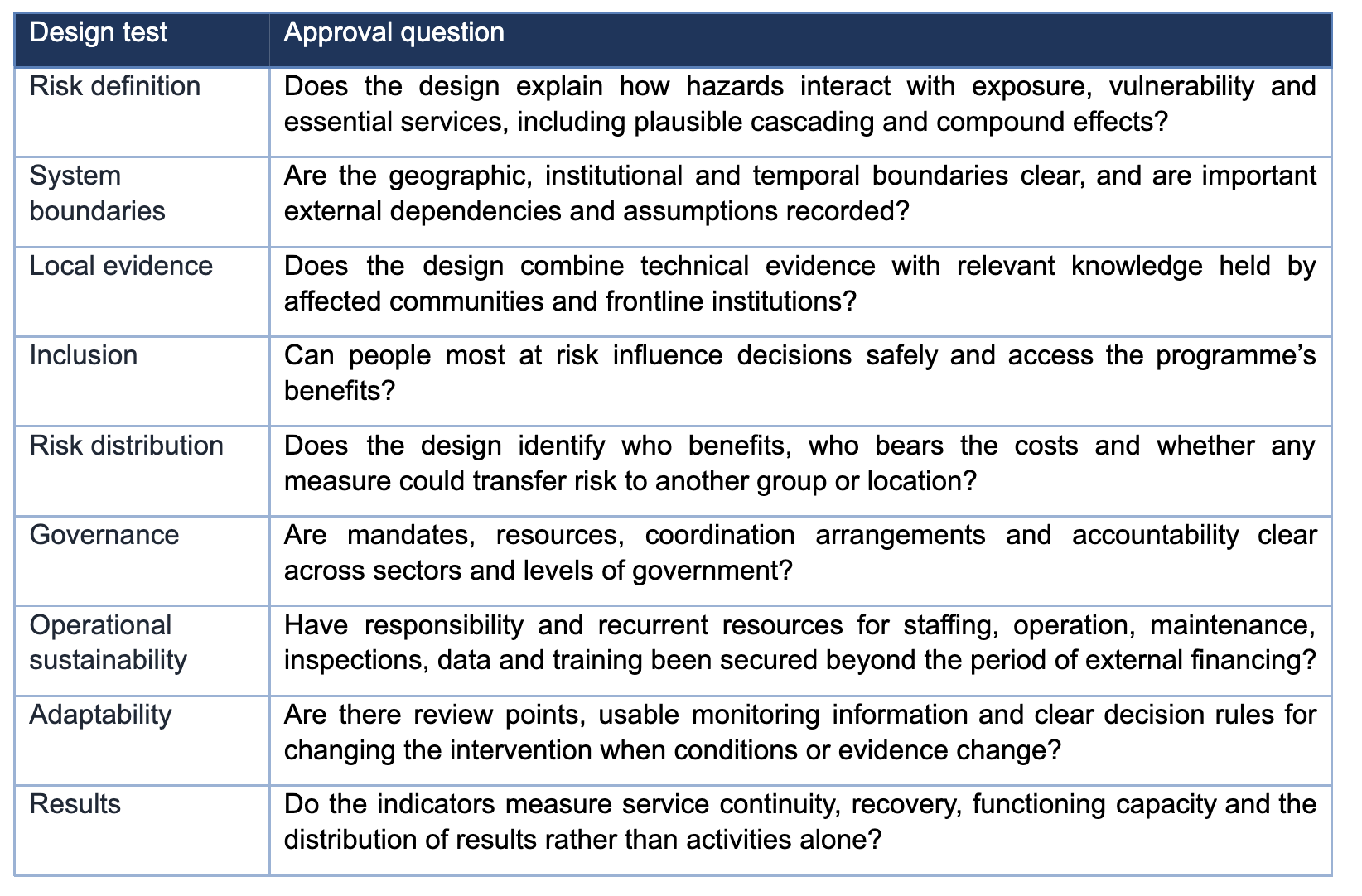
Implications for International Organisations & Funders
A best-fit approach may require international organisations and funders to adjust some of their own practices. Short inception periods, predetermined activity lists and inflexible annual targets can constrain serious local diagnosis, co-design and adaptation. Calls for proposals may require participation while leaving implementing partners and affected communities little practical scope to influence the intervention. Funding arrangements may also favour visible capital expenditure while giving insufficient attention to recurrent costs, institutional capacity, maintenance and long-term operation.
International organisations can improve programme quality by financing context analysis and co-design as substantive programme activities; allowing justified changes to delivery plans; examining the political economy and distribution of risk; and requiring a credible operational sustainability plan before major assets are procured. Partnerships should recognise local organisations as knowledge holders, decision-making partners and delivery actors, with responsibilities, budgets and influence proportionate to their expected contribution.
Adaptation to context should not weaken standards concerning safety, human rights, environmental protection, evidence or accountability. Where international standards are non-negotiable, programme teams should explain their purpose clearly and work with national and local actors to identify the technical assistance, resources, institutional changes and implementation sequence needed to meet them. Any phased route to compliance should be used only where the applicable standard permits it and should include clear responsibilities, milestones and safeguards.
Monitoring should support learning and decision-making rather than function solely as reporting to funders. Programme reviews should examine whether key assumptions remain valid, whether benefits are reaching the intended groups, whether an intervention is transferring risk elsewhere and whether responsible institutions can act on the information being produced. Monitoring should also identify unintended consequences and changing operating conditions. This creates a basis for responsible adaptation without weakening transparency or accountability.
Conclusion
Disaster resilience is shaped through repeated decisions about land, infrastructure, public services, livelihoods, ecosystems and inclusion. Emergency response remains essential, but it cannot compensate for development decisions that continue to create or concentrate exposure and vulnerability.
International programmes can make a stronger contribution when they begin with the local risk system rather than a predetermined solution. This means mapping dependencies, clarifying authority, enabling affected people to influence decisions, financing long-term institutional and operational capacity, and changing course when evidence requires it.
Best practice provides valuable principles, standards and experience. A best-fit approach applies them in a form that can function in a particular place, under real institutional conditions, for the people whose resilience the programme is intended to strengthen.
Ada Schmidtkunz, Senior Programme Delivery Manager